Tuesday, September 29, 2009
Michael's Film Shots
This shot goes from long shot to midrange shot from a low angle. While the low angle is normally used to show power, the idea here was to reverse the effect by emphasizing my confusion at being on a roof with no way down, and the vulnerability that the situation causes.
This is a documentary style point of view shot that shows a person running in a haphazard way, implying fear or running from danger. Instead of actually showing the runner, this view puts the audience in the place of the runner, viewing the world as the character does.
This midrange shot utilizes negative space along with my apparent fear to imply for the viewer that something bad is going to come from the left, which comes true when I get my throat slit.

Monday, September 28, 2009
The memento of flashback
Well, when looking at the movie Memento lots of things come to mind. Christopher Nolan did a great job of keeping me on my feet at all times. At times I was so confused by the plot and plight of our "hero" that I would just want to stop the movie for a little bit and take a deep breathe to take everything in. Lenny had a unique way of keeping track of things and different camera angles would come up at just the right time to make it seem like we were viewing the scene from Lenny's eyes. Another thing I didn't really get the whole movie is the plot line. It was rather ingenious for Nolan to make us witness the entire movie in reverse and make it seem like Lenny created a way for him to keep himself in his own little fantasy. Thinking about it though.. what else would Lenny be good for, he couldn't hold down a job or do every day tasks unless he learned them before his terrible accident.
Sunday, September 20, 2009
Casablanca

After watching the film Casablanca, I could not help but notice how Rick's character was portrayed as very cold and unconcerned with others. He even says "I stick my neck out for nobody." On the surface, it appears that Rick truly is an apathetic man but as the film progresses the viewer can clearly see that this is just an act Rick puts on. Rick probably decides to act tough and apathetic so that he will not be seen as a vulnerable person, but the fact is that he really does have a sense of moral responsibility. For example, Rick helps the Bulgarians win money on the roulette in his bar. Even though he knows that helping them will be at the expense of his business' money, he still helps them because he knows that it is the proper thing to do when people are in need. Also, at the end of the film Rick arranges for Ilsa and Victor to leave Casablanca even though he could have used the documents for his own exit from Casablanca. So, in the end the seemingly tough Rick who "sticks his neck out for nobody" becomes a responsible and respectable man who does what he believes is right.
Thursday, September 17, 2009
Nothing New Under The Sun
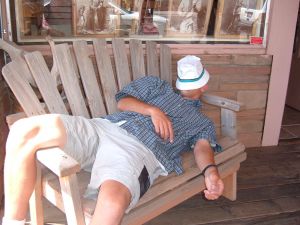
With the movies we've seen so far, it seems like everybody's first reaction is always that the movie was too predictable. "I knew the boy was going to get eaten in Jaws, I knew the girl had to die in Flying Daggers, and the love plot in Casablanca was cliche, etc." The thing is, there really wasn't anything that the directors could have done differently. If you think about it, they say that in literature, there are only seven possible plots (man v. nature, man vs. self, man v. society, etc.), so you already are very limited with what you can make a film about. So even with variations in plots, its only natural that films would develop formulas that are proven to deliver the right message to the audience, such as the Classic style utilized in Casablanca. Really, the only way to make a completely unpredictable movie, you would have to film real life, which for most people would end up looking like the shot you see below. It is a given that an intelligent viewer will be able to predict the outcome of most every movie with a little background knowledge, so instead we should focus on the excellent uses of the various film styles shown in these films.


Sunday, September 13, 2009
House of Flying Daggers of Predictability
House of Flying Daggers is an interesting movie, Chinese, yet still it was filled with many typical American Hollywood characteristics. It has the makings of a great kung-fu/martial arts movie, touching on politics and ethics, but eventually we find out that the main point is not dealing with the government but rather a love story. It's the classic Hollywood setup: two opposing sides. A member of each side runs into the other. They both at first dislike each other but they fall in love. Then of course either one or both of them has to die. A typical Romeo and Juliet scenario. Especially the end battle here:
Very preditictable in the sense that they wanted to make it very epic like when the weather randomly changes from fall-like to a heavy blanket of snow within 5 seconds. One is the jealous man who also loves the main female character and the other is her true love and both of course have to basically duke it out to prove almost which one is more worthy.
Many of the fight scenes in the movie take the 'Matrix' approach to things with the camera following the blade or arrow as it travels towards its victim in an almost slow-motion way. They probably did this to appeal more to American people and the style of fight scenes we are used to as well as to try to keep Asian interest by keeping the kung-fu style there. Personally, I think this strategy worked because I loved the fight scenes. It was the type that just made me go "OH MY GOSH!! That is so cool!". However, not everyone likes this style yet it was used in every single fight scene. They tried to Americanize the movie a little too much (with the slow motion, the predictable ending, etc) but I think it was successful in selling it to most of the American people :)
Very preditictable in the sense that they wanted to make it very epic like when the weather randomly changes from fall-like to a heavy blanket of snow within 5 seconds. One is the jealous man who also loves the main female character and the other is her true love and both of course have to basically duke it out to prove almost which one is more worthy.
Many of the fight scenes in the movie take the 'Matrix' approach to things with the camera following the blade or arrow as it travels towards its victim in an almost slow-motion way. They probably did this to appeal more to American people and the style of fight scenes we are used to as well as to try to keep Asian interest by keeping the kung-fu style there. Personally, I think this strategy worked because I loved the fight scenes. It was the type that just made me go "OH MY GOSH!! That is so cool!". However, not everyone likes this style yet it was used in every single fight scene. They tried to Americanize the movie a little too much (with the slow motion, the predictable ending, etc) but I think it was successful in selling it to most of the American people :)
Monday, September 7, 2009
Reading Response: Profit margins=pointless films
In the excerpt from the Oxford Guide called "Concepts of Culture: cultural policies and the cultural industries," Nicholas Garnham discusses the effects on mass consumerism in our profit driven capitalism on the cultural industries, which include the film industry. Previous class readings and discussions showed that the "auteur theory" is not truly applicable to films; films are not works that purely display the meaning intended by a single creator, but a product for profit created through the work of hundreds of people under the direction of the studio. Despite this handicap though, the film is still a legitimate medium that can convey important insights into human nature and social phenomenon, just like any book, painting, or other work of art.
Unfortunately, according to Garnham's essay, the studios have come to the point where they must aim at audience maximization when producing, drawing as many people to the film as possible to maximize profit before the film hits the underground market. To do this, the industry often relies on formulaic plots, such as this example from comedy website Cracked.com:
Unfortunately, according to Garnham's essay, the studios have come to the point where they must aim at audience maximization when producing, drawing as many people to the film as possible to maximize profit before the film hits the underground market. To do this, the industry often relies on formulaic plots, such as this example from comedy website Cracked.com:
Ultra-Masculine Action Star Gets Stuck With Small Child or Children

When Hollywood discovers a plot line that draws large crowds, they then produce several other releases with an identical idea because they are sure it will work. The result is a string of unoriginal movies with no intellectual value, defeating the purpose of film as an art.
The thing that Hollywood has not fully grasped, is that audiences will in fact go see a movie with a controversial, thought driven plot, as long as it still has an effective amount of special effects, action, and sex thrown in to appease the less cultured class of movie viewers. For example, the recent film, Watchmen, directed by Zach Snyder, made over $50 million profit. It not only contained a plethora of action, fighting, sex scenes, and effects, but was also driven by a highly philosophical plot, where a utilitarian genius creates world peace by nuking all the world's major cities. After much infighting and thought provoking discussion, the heroes decide that the controversial action is in fact justified, and kill the remaining dissenter to keep the peace, as seen in this clip:
This is proof that film makers can afford to take risks with their plots and still be successful economically. Once Hollywood adopts this viewpoint across the board, film will regain its place as a respectable, meaningful art form.
Wednesday, September 2, 2009
Dun...Dun... Shark Attack!
Jaws, was a great movie from many view points. Spielberg did a great job using all of the tools at his disposal to create a scary movie. Using society's fears against them is a powerful weapons as you can see from the movie. Also if you look at statistics from beach attendance the year Jaws was released, one will find that attendance was at a record low.
There are many aspects to this movie that play with the audience's senses. Spielberg leads us on to believe that every time you hear the characteristic "Dun..Dun" melody of music a shark attack is coming. Well most of the time this is true, but it creates almost a similar situation to that of Pavlov's dogs. One begins to associate a sound with a particular action or occurrence.
There are also many background issues that are highlighted in this movie, by the rule of thirds Spielberg highlights the importance of certain characters throughout the movie so the audience's eyes are guided toward the center of the screen. Also the camera zooming in and out draws significance either toward or away from the characters depending on the surroundings. This was used much in conjunction with shark attacks to put emphasis on "Jaws".
There are many aspects to this movie that play with the audience's senses. Spielberg leads us on to believe that every time you hear the characteristic "Dun..Dun" melody of music a shark attack is coming. Well most of the time this is true, but it creates almost a similar situation to that of Pavlov's dogs. One begins to associate a sound with a particular action or occurrence.
There are also many background issues that are highlighted in this movie, by the rule of thirds Spielberg highlights the importance of certain characters throughout the movie so the audience's eyes are guided toward the center of the screen. Also the camera zooming in and out draws significance either toward or away from the characters depending on the surroundings. This was used much in conjunction with shark attacks to put emphasis on "Jaws".
"Jaw(s)" Dropping Movie
The film Jaws, directed by Spielberg, is an example of how Hollywood transitioned to make action-packed and technologically advanced films. These films were able to draw back in the moviegoers that Hollywood had lost to other forms of entertainment such as the television, VCR, and HBO. Jaws was an appealing movie to audiences because of its ability to keep viewers glued to their seat in suspense of when the next shark attack would occur on Amity Island. Not only does the film incorporate new technology such as the use of a realistic shark but it also evokes intense emotions out of the viewer. In the clip shown above, the chief encounters the shark face-to-face. His silence after this encounter is effective in making the viewer share this fear and shock. After he steps back into the cabin, he says that they need a bigger boat and this is important because it is when the true power and strength of the shark become a reality for the chief.
Subscribe to:
Posts (Atom)