Thursday, October 29, 2009

Tuesday, October 27, 2009
The French Know How Appreciate the Small Things
The French have always seemed to be good at boiling life down o its bare essentials. French thinkers, such as Sartre emphasized the fact that the world as it exists in itself has no inherent meaning, purpose, or higher goals; all of these things are products of the human imagination. Therefore, it seems logical that if we are able to construct meaningful value from high strung topics such as politics, ethics, race relations, etc, then we must also be capable of deriving meaning from simpler things, such as nature, small comedic anecdotes, or even changes in perspective. This is the sort of meaning aimed at by the French New Wave directors.
According to Jill Forbes' essay, "The French Nouvelle Vague," "...the moral message of Nouvelle Vague films was to be indistinguishable from their aesthetics..." Even though many of these New Wave films did include higher level themes such as love, social commentary, and politics, much of the focus in the films was on the minutia of everyday life. An excellent example of this would be the film "The 400 Blows," whos ending scene is shown above. The plot was driven by the story of a troubled child who was not understood or loved by his parents, causing a desire for independence and acceptance. The story included a troubled parental couple, living in a correctional facility, and juvenile delinquency. In a typical American film, these elements would have been the main focus, but at the end of this film, we don't see a neat fix for the poor boy's troubles. All we see is his satisfaction at walking in the ocean, a simple childhood fantasy.
While many viewers in this country would see that and feel frustrated at the apparent clip hanger, someone who understands the film's intention would be satisfied. Even though none of the child's problems have disappeared, (his parents have disowned him, he is alone, and is now a fugitive), this small moment in the water represents his freedom; he sees an open ocean that represents his ability to take himself anywhere he wants to go in his life, and all of that complex meaning was wrapped in a simple minute long experience. That is the power of the Nouvelle Vague; once one understands that meaning can be given to any thing on earth, one can watch the film and derive endless pleasure and satisfaction at life as it is, without the added thrills and twists that Hollywood depends on to keep its audience interested.
 ---------------->
Friday, October 16, 2009
Unforgiven Shatters the Myth
In Ryall's essay on Hollywood genres, it was said of genres, "genre films, television, and literature have to a great extent replaced more formal versions of mythic response to existence such as religion and folk tale." According to this idea, film is a medium through which people can view the world, creating a framework of how life is/ should be based on the focus of the screen. This is comparble to the way the ancients used their mythic stories of Gods and heros, or how modern people use religious texts to build a system of morality.
If this idea is applied to classic westerns such as The Searchers, then the prevailing myth would be that of an ideal American Paradise, where strong, independent people lived in a prosperous frontier, performing their duties of expanding the nation's borders, ridding the continent of savages, and using killing as a first resort for justice. This image gives the audience a skewed idea of reality; despite their knowledge to the contrary, they truly want to believe that there was a time and place when problems could be legitimately solved by killing your enemies then forgetting it ever happened. Unforgiven on the other hand, broke down that mythic barrier, showing audiences a realist view of how the world would be if the classic western frame were actually carried out.
From the very beginning, we are shown a main character who has actually lived the life of the classic cowboy figure, killing, drinking, and wandering freely around the new frontier, but in his later years he is not a glorified hero, but a poor, lonely, emotionally unstable man who regrets his past. Upon trying to relive the old days, or in the kid's case, mimic them, the men come to the realization that the system of killing men over disputes is immoral and an act that will leave you feeling bad about yourself. This realist view of a cowboy's mythic lifestyle completely shatters the framework that classic westerns such as The Searchers built up. Instead of walking away feeling the hero's glory from getting his revenge, the audience walks away feeling uneasy, as if they themselves had committed an immoral act simply by wishing for the success of the killing as they had in past westerns. Like other westerns, Unforgiven does provide a moral framework from which one could base their actions, but this time it is not a myth; it is a framework made of a real world where actions have consequences.
If this idea is applied to classic westerns such as The Searchers, then the prevailing myth would be that of an ideal American Paradise, where strong, independent people lived in a prosperous frontier, performing their duties of expanding the nation's borders, ridding the continent of savages, and using killing as a first resort for justice. This image gives the audience a skewed idea of reality; despite their knowledge to the contrary, they truly want to believe that there was a time and place when problems could be legitimately solved by killing your enemies then forgetting it ever happened. Unforgiven on the other hand, broke down that mythic barrier, showing audiences a realist view of how the world would be if the classic western frame were actually carried out.
From the very beginning, we are shown a main character who has actually lived the life of the classic cowboy figure, killing, drinking, and wandering freely around the new frontier, but in his later years he is not a glorified hero, but a poor, lonely, emotionally unstable man who regrets his past. Upon trying to relive the old days, or in the kid's case, mimic them, the men come to the realization that the system of killing men over disputes is immoral and an act that will leave you feeling bad about yourself. This realist view of a cowboy's mythic lifestyle completely shatters the framework that classic westerns such as The Searchers built up. Instead of walking away feeling the hero's glory from getting his revenge, the audience walks away feeling uneasy, as if they themselves had committed an immoral act simply by wishing for the success of the killing as they had in past westerns. Like other westerns, Unforgiven does provide a moral framework from which one could base their actions, but this time it is not a myth; it is a framework made of a real world where actions have consequences.
Tuesday, October 13, 2009
Unforgiven- Clash of mentality
This really was an interesting movie in terms of how our hero is portrayed. The main question throughout the whole movie is, " Well is Clint Eastwood the Hero or just playing the part for the money?" He does a great job of keeping his actual intentions hidden from the audience through the whole movie. What I did find odd though is how he seemed to revert back old very easily after Ned decided not to kill the first cowboy that butchered the whore. Munny (Eastwood) did have some defining traits that made him a hero. Granted after Ned was "accidentally" killed, he was more after revenge than anything else. This anti-hero/hero inner class is very common in Clint Eastwood movies, but it my opinion it is these that really make his movies great.
All in all, this movie was very enjoyable but a little on the long side. It is slightly unfair to compare this movie to Gran Torino, the most recent Eastwood movie I have seen, but his character shares many of the same aspect between the two movies. Each character has just gone through a period of great loss, and is a bit on the "crazy" or how shall you say "disgruntled/angry" side. They do go through redemption in a unique way, but they do find peace with what they have done.
Sunday, October 11, 2009
The Searchers- A Typical Western
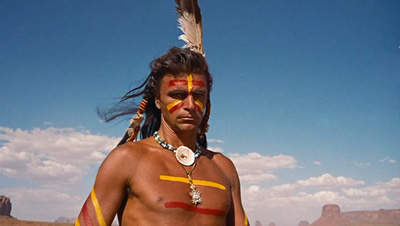
In many ways The Searchers can be seen as a predictable western film that incorporates many of the same storylines and elements that have previously been used. Producers and film companies repeated the same formulaic plots and ideas because they were well-received by audiences and so they were an easy way to ensure that the film would be successful. The Searchers follows many of these formulaic ideas. For example, the Indians are seen as savage and bloodthirsty. A common theme is when someone is murdered or kidnapped, and so a journey begins in order to find out who did it and how to get revenge. In The Searchers the Indian tribe (with the leader Scar) kidnaps a girl and this causes Ethan and Martin to go out looking for her for many years. Usually in westerns they portray the Indians from a distance and in a large group. The Searchers does this, but it also deviates and introduces a whole new concept. The Searchers spends some time showing the Indian tribe leader, Scar, up close and the viewer even gains a sense of his character which was previously unheard of in a western film. Even though The Searchers is an action movie, I could not help feel bored and disinterested with the movie. It was much too predictable and I felt like I had seen the movie about a thousand times before even though I have never even watched The Searchers. It definitely lacked an originality (from the gunfights to the same musical score playing throughout the entire movie) and I was left feeling uninspired.
Monday, October 5, 2009
Crash exposes the roots of racism
It is very common in films to have characters that portray some group, usually racial minorities, in a negative light, using stereotypes. In most instances, the stereotype is placed into a film to reinforce people's prejudices and beliefs. For instance, a film will portray Native Americans as violent and savage, not because that image is true or justified in any way, but simply because that is what society as a whole thinks of and expects when Native Americans are mentioned. Crash used this same technique to its fullest extent, including almost every common stereotype known in American society, not to appease people's prejudices like other films, but to make the audience feel uncomfortable with their way of thinking and explore the causes of that prejudiced thinking. At first it seems like the movie is simply showing that everybody comes into contact with racism, either as a cause or victim almost every day, but on closer inspection the movie shows a pattern that explains the deepest roots of racism, which is fear.
In almost every storyline in the movie, racial slurs or prejudices are sparked by a situation that makes the "racist" fear for their safety from a member of another race. For instance, when the Persian shop keeper goes to buy a gun, the store owner seems to have no problem selling the gun until the two start speaking Farsi. This language barrier makes the salesman uncomfortable as he cannot know what they are talking about, and allows his mind to connect 9-11 and the Middle Eastern customers. Even though it is not logical that the two would be terrorists, the man lets his ignorance of foreign cultures cause fear of different people, which is masked by hatred of that people.
This pattern is repeated throughout the movie; the white women shows prejudice against Hispanics because they are the nearest target when she feels her family is in danger; the officer shows prejudice against blacks because he fears that his father is dying as a result of affirmative action for blacks; the younger officer shoots the black man because of his fear that the man will conform to the violent stereotype.
For every instance of prejudice these people display, they show later that they can relate to other races when they are not feeling threatened; the white woman admits her love for the Hispanic maid; the "racist" officer risks his life for the black woman; the other officer vouches for a violently angry black man. All of these instances show that every person is capable of love for members of other races outside of threatening situations, proving that if people were to lose their fear of the unknown or the different, then racism would be a thing of the past.

In almost every storyline in the movie, racial slurs or prejudices are sparked by a situation that makes the "racist" fear for their safety from a member of another race. For instance, when the Persian shop keeper goes to buy a gun, the store owner seems to have no problem selling the gun until the two start speaking Farsi. This language barrier makes the salesman uncomfortable as he cannot know what they are talking about, and allows his mind to connect 9-11 and the Middle Eastern customers. Even though it is not logical that the two would be terrorists, the man lets his ignorance of foreign cultures cause fear of different people, which is masked by hatred of that people.
This pattern is repeated throughout the movie; the white women shows prejudice against Hispanics because they are the nearest target when she feels her family is in danger; the officer shows prejudice against blacks because he fears that his father is dying as a result of affirmative action for blacks; the younger officer shoots the black man because of his fear that the man will conform to the violent stereotype.
For every instance of prejudice these people display, they show later that they can relate to other races when they are not feeling threatened; the white woman admits her love for the Hispanic maid; the "racist" officer risks his life for the black woman; the other officer vouches for a violently angry black man. All of these instances show that every person is capable of love for members of other races outside of threatening situations, proving that if people were to lose their fear of the unknown or the different, then racism would be a thing of the past.

Subscribe to:
Posts (Atom)