 Brick Lane was an interesting feminist film which gives insight into a woman named Nazneen’s life. Nazneen used to live in Bangladesh, but when she was a teenager she moved to London with her husband. The film shows Nazneen’s unhappiness in the life that she is leading. Even though she has two daughters that she loves very much, she misses her sister back home and is living with a husband who she does not love. Her husband’s character is important to understand when talking about this film. At the beginning, her husband appears to be cold-hearted, indifferent, and out of touch with his family’s feelings. However, his character evolves throughout the movie. It becomes apparent that he begins to make changes in order to try to make his family happier. For example, he plans for them to go on a vacation and he spends his time taking pictures and leading them to all of the sights that they should see. At first, the audience hates Nazneen’s husband. But, towards the end of the movie I almost felt sorry for him. He was trying to make his marriage work and be more attentive to his wife even though she was having an affair behind his back, he showed true pain and hurt when he got into an argument with his daughter, he made a very bold and intelligent speech at the Muslim meeting, and he was going back to Bangladesh while leaving his family behind. He evolves from a very simple character to one that is much more complex and this allows people to sympathize with him because he is depicted as a more realistic human being. Another important aspect of this movie to discuss would be Nazneen’s affair. At first this affair appears to be with a man that she could pursue a relationship with after her husband leaves. However, we soon come to understand that Nazneen was only physically attracted to this man. The affair is more of a representation of Nazneen’s newfound freedom rather than an actual love that she will pursue because she soon finds things about him that she does not like.
Sunday, November 15, 2009
Brick Lane
Brick Lane was an interesting feminist film which gives insight into a woman named Nazneen’s life. Nazneen used to live in Bangladesh, but when she was a teenager she moved to London with her husband. The film shows Nazneen’s unhappiness in the life that she is leading. Even though she has two daughters that she loves very much, she misses her sister back home and is living with a husband who she does not love. Her husband’s character is important to understand when talking about this film. At the beginning, her husband appears to be cold-hearted, indifferent, and out of touch with his family’s feelings. However, his character evolves throughout the movie. It becomes apparent that he begins to make changes in order to try to make his family happier. For example, he plans for them to go on a vacation and he spends his time taking pictures and leading them to all of the sights that they should see. At first, the audience hates Nazneen’s husband. But, towards the end of the movie I almost felt sorry for him. He was trying to make his marriage work and be more attentive to his wife even though she was having an affair behind his back, he showed true pain and hurt when he got into an argument with his daughter, he made a very bold and intelligent speech at the Muslim meeting, and he was going back to Bangladesh while leaving his family behind. He evolves from a very simple character to one that is much more complex and this allows people to sympathize with him because he is depicted as a more realistic human being. Another important aspect of this movie to discuss would be Nazneen’s affair. At first this affair appears to be with a man that she could pursue a relationship with after her husband leaves. However, we soon come to understand that Nazneen was only physically attracted to this man. The affair is more of a representation of Nazneen’s newfound freedom rather than an actual love that she will pursue because she soon finds things about him that she does not like.

Gay and Lesbian Film
Gay and lesbians have been included in films for a while, however many times they were included as very flat characters that were looked down upon or simply included in the film to provide comic relief. Some critics say that any type of visibility of gay or lesbians in film is better than none at all whereas others disagree. Stereotyping of homosexuals was very common in films. Many times homosexuals were portrayed as “the sissy, the sad young man, the gay psychopath, the seductive androgyne, the unnatural woman, or the lesbian vampire.” Critics argue that the focus is not to eliminate stereotypes and replace them with positive images. Rather, the idea is that homosexuals should be represented as more complex and diverse rather than just simplistic and entertaining. During a certain time in Hollywood, it was deemed inappropriate to depict homosexual relationships. So, instead filmmakers used metaphors and symbolic scenes to subtly hint at homosexuality. Critics also argue that many films have homosexual undertones because obviously if a male body is shown and the audience is a mix of men and women then the males watching the film will view it as well and vice versa with a female body.
Sunday, November 8, 2009
Feminism... A Confusing study
When looking at Feminism many people wonder what the real argument is. With all of the different "theories" or motivations, it is a real wonder that a solid definition can be concluded upon. There are many movies, that fall into many subcategories, which exemplify feminist ideals. When you look at things like reflection theory, it seems that many critics overshadow many of the main issues directors intend others to look at and instead focus on a very narrow minded view. This can be expressed as in ways such as having a female black slave doing demeaning work, but feminist critics who only analyze the face that there is a female doing demeaning work not that she shouldn't be doing. All of these things don't really add up to an effective argument, but it does create a starting point. However, do display positive things about women. These movies greatly bring out many of the strengths of women along with how that they can be strong and independent on an equal playing field with men. Movies such as A league of Their Own and Juno are modern examples of how women can be viewed on equal playing fields as their male counterparts.
Thursday, October 29, 2009
Tuesday, October 27, 2009
The French Know How Appreciate the Small Things
The French have always seemed to be good at boiling life down o its bare essentials. French thinkers, such as Sartre emphasized the fact that the world as it exists in itself has no inherent meaning, purpose, or higher goals; all of these things are products of the human imagination. Therefore, it seems logical that if we are able to construct meaningful value from high strung topics such as politics, ethics, race relations, etc, then we must also be capable of deriving meaning from simpler things, such as nature, small comedic anecdotes, or even changes in perspective. This is the sort of meaning aimed at by the French New Wave directors.
According to Jill Forbes' essay, "The French Nouvelle Vague," "...the moral message of Nouvelle Vague films was to be indistinguishable from their aesthetics..." Even though many of these New Wave films did include higher level themes such as love, social commentary, and politics, much of the focus in the films was on the minutia of everyday life. An excellent example of this would be the film "The 400 Blows," whos ending scene is shown above. The plot was driven by the story of a troubled child who was not understood or loved by his parents, causing a desire for independence and acceptance. The story included a troubled parental couple, living in a correctional facility, and juvenile delinquency. In a typical American film, these elements would have been the main focus, but at the end of this film, we don't see a neat fix for the poor boy's troubles. All we see is his satisfaction at walking in the ocean, a simple childhood fantasy.
While many viewers in this country would see that and feel frustrated at the apparent clip hanger, someone who understands the film's intention would be satisfied. Even though none of the child's problems have disappeared, (his parents have disowned him, he is alone, and is now a fugitive), this small moment in the water represents his freedom; he sees an open ocean that represents his ability to take himself anywhere he wants to go in his life, and all of that complex meaning was wrapped in a simple minute long experience. That is the power of the Nouvelle Vague; once one understands that meaning can be given to any thing on earth, one can watch the film and derive endless pleasure and satisfaction at life as it is, without the added thrills and twists that Hollywood depends on to keep its audience interested.
 ---------------->
Friday, October 16, 2009
Unforgiven Shatters the Myth
In Ryall's essay on Hollywood genres, it was said of genres, "genre films, television, and literature have to a great extent replaced more formal versions of mythic response to existence such as religion and folk tale." According to this idea, film is a medium through which people can view the world, creating a framework of how life is/ should be based on the focus of the screen. This is comparble to the way the ancients used their mythic stories of Gods and heros, or how modern people use religious texts to build a system of morality.
If this idea is applied to classic westerns such as The Searchers, then the prevailing myth would be that of an ideal American Paradise, where strong, independent people lived in a prosperous frontier, performing their duties of expanding the nation's borders, ridding the continent of savages, and using killing as a first resort for justice. This image gives the audience a skewed idea of reality; despite their knowledge to the contrary, they truly want to believe that there was a time and place when problems could be legitimately solved by killing your enemies then forgetting it ever happened. Unforgiven on the other hand, broke down that mythic barrier, showing audiences a realist view of how the world would be if the classic western frame were actually carried out.
From the very beginning, we are shown a main character who has actually lived the life of the classic cowboy figure, killing, drinking, and wandering freely around the new frontier, but in his later years he is not a glorified hero, but a poor, lonely, emotionally unstable man who regrets his past. Upon trying to relive the old days, or in the kid's case, mimic them, the men come to the realization that the system of killing men over disputes is immoral and an act that will leave you feeling bad about yourself. This realist view of a cowboy's mythic lifestyle completely shatters the framework that classic westerns such as The Searchers built up. Instead of walking away feeling the hero's glory from getting his revenge, the audience walks away feeling uneasy, as if they themselves had committed an immoral act simply by wishing for the success of the killing as they had in past westerns. Like other westerns, Unforgiven does provide a moral framework from which one could base their actions, but this time it is not a myth; it is a framework made of a real world where actions have consequences.
If this idea is applied to classic westerns such as The Searchers, then the prevailing myth would be that of an ideal American Paradise, where strong, independent people lived in a prosperous frontier, performing their duties of expanding the nation's borders, ridding the continent of savages, and using killing as a first resort for justice. This image gives the audience a skewed idea of reality; despite their knowledge to the contrary, they truly want to believe that there was a time and place when problems could be legitimately solved by killing your enemies then forgetting it ever happened. Unforgiven on the other hand, broke down that mythic barrier, showing audiences a realist view of how the world would be if the classic western frame were actually carried out.
From the very beginning, we are shown a main character who has actually lived the life of the classic cowboy figure, killing, drinking, and wandering freely around the new frontier, but in his later years he is not a glorified hero, but a poor, lonely, emotionally unstable man who regrets his past. Upon trying to relive the old days, or in the kid's case, mimic them, the men come to the realization that the system of killing men over disputes is immoral and an act that will leave you feeling bad about yourself. This realist view of a cowboy's mythic lifestyle completely shatters the framework that classic westerns such as The Searchers built up. Instead of walking away feeling the hero's glory from getting his revenge, the audience walks away feeling uneasy, as if they themselves had committed an immoral act simply by wishing for the success of the killing as they had in past westerns. Like other westerns, Unforgiven does provide a moral framework from which one could base their actions, but this time it is not a myth; it is a framework made of a real world where actions have consequences.
Tuesday, October 13, 2009
Unforgiven- Clash of mentality
This really was an interesting movie in terms of how our hero is portrayed. The main question throughout the whole movie is, " Well is Clint Eastwood the Hero or just playing the part for the money?" He does a great job of keeping his actual intentions hidden from the audience through the whole movie. What I did find odd though is how he seemed to revert back old very easily after Ned decided not to kill the first cowboy that butchered the whore. Munny (Eastwood) did have some defining traits that made him a hero. Granted after Ned was "accidentally" killed, he was more after revenge than anything else. This anti-hero/hero inner class is very common in Clint Eastwood movies, but it my opinion it is these that really make his movies great.
All in all, this movie was very enjoyable but a little on the long side. It is slightly unfair to compare this movie to Gran Torino, the most recent Eastwood movie I have seen, but his character shares many of the same aspect between the two movies. Each character has just gone through a period of great loss, and is a bit on the "crazy" or how shall you say "disgruntled/angry" side. They do go through redemption in a unique way, but they do find peace with what they have done.
Sunday, October 11, 2009
The Searchers- A Typical Western
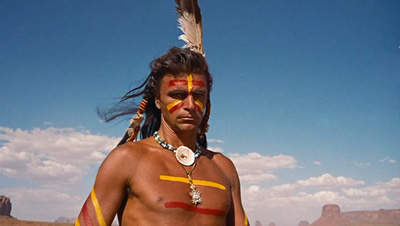
In many ways The Searchers can be seen as a predictable western film that incorporates many of the same storylines and elements that have previously been used. Producers and film companies repeated the same formulaic plots and ideas because they were well-received by audiences and so they were an easy way to ensure that the film would be successful. The Searchers follows many of these formulaic ideas. For example, the Indians are seen as savage and bloodthirsty. A common theme is when someone is murdered or kidnapped, and so a journey begins in order to find out who did it and how to get revenge. In The Searchers the Indian tribe (with the leader Scar) kidnaps a girl and this causes Ethan and Martin to go out looking for her for many years. Usually in westerns they portray the Indians from a distance and in a large group. The Searchers does this, but it also deviates and introduces a whole new concept. The Searchers spends some time showing the Indian tribe leader, Scar, up close and the viewer even gains a sense of his character which was previously unheard of in a western film. Even though The Searchers is an action movie, I could not help feel bored and disinterested with the movie. It was much too predictable and I felt like I had seen the movie about a thousand times before even though I have never even watched The Searchers. It definitely lacked an originality (from the gunfights to the same musical score playing throughout the entire movie) and I was left feeling uninspired.
Monday, October 5, 2009
Crash exposes the roots of racism
It is very common in films to have characters that portray some group, usually racial minorities, in a negative light, using stereotypes. In most instances, the stereotype is placed into a film to reinforce people's prejudices and beliefs. For instance, a film will portray Native Americans as violent and savage, not because that image is true or justified in any way, but simply because that is what society as a whole thinks of and expects when Native Americans are mentioned. Crash used this same technique to its fullest extent, including almost every common stereotype known in American society, not to appease people's prejudices like other films, but to make the audience feel uncomfortable with their way of thinking and explore the causes of that prejudiced thinking. At first it seems like the movie is simply showing that everybody comes into contact with racism, either as a cause or victim almost every day, but on closer inspection the movie shows a pattern that explains the deepest roots of racism, which is fear.
In almost every storyline in the movie, racial slurs or prejudices are sparked by a situation that makes the "racist" fear for their safety from a member of another race. For instance, when the Persian shop keeper goes to buy a gun, the store owner seems to have no problem selling the gun until the two start speaking Farsi. This language barrier makes the salesman uncomfortable as he cannot know what they are talking about, and allows his mind to connect 9-11 and the Middle Eastern customers. Even though it is not logical that the two would be terrorists, the man lets his ignorance of foreign cultures cause fear of different people, which is masked by hatred of that people.
This pattern is repeated throughout the movie; the white women shows prejudice against Hispanics because they are the nearest target when she feels her family is in danger; the officer shows prejudice against blacks because he fears that his father is dying as a result of affirmative action for blacks; the younger officer shoots the black man because of his fear that the man will conform to the violent stereotype.
For every instance of prejudice these people display, they show later that they can relate to other races when they are not feeling threatened; the white woman admits her love for the Hispanic maid; the "racist" officer risks his life for the black woman; the other officer vouches for a violently angry black man. All of these instances show that every person is capable of love for members of other races outside of threatening situations, proving that if people were to lose their fear of the unknown or the different, then racism would be a thing of the past.

In almost every storyline in the movie, racial slurs or prejudices are sparked by a situation that makes the "racist" fear for their safety from a member of another race. For instance, when the Persian shop keeper goes to buy a gun, the store owner seems to have no problem selling the gun until the two start speaking Farsi. This language barrier makes the salesman uncomfortable as he cannot know what they are talking about, and allows his mind to connect 9-11 and the Middle Eastern customers. Even though it is not logical that the two would be terrorists, the man lets his ignorance of foreign cultures cause fear of different people, which is masked by hatred of that people.
This pattern is repeated throughout the movie; the white women shows prejudice against Hispanics because they are the nearest target when she feels her family is in danger; the officer shows prejudice against blacks because he fears that his father is dying as a result of affirmative action for blacks; the younger officer shoots the black man because of his fear that the man will conform to the violent stereotype.
For every instance of prejudice these people display, they show later that they can relate to other races when they are not feeling threatened; the white woman admits her love for the Hispanic maid; the "racist" officer risks his life for the black woman; the other officer vouches for a violently angry black man. All of these instances show that every person is capable of love for members of other races outside of threatening situations, proving that if people were to lose their fear of the unknown or the different, then racism would be a thing of the past.

Tuesday, September 29, 2009
Michael's Film Shots
This shot goes from long shot to midrange shot from a low angle. While the low angle is normally used to show power, the idea here was to reverse the effect by emphasizing my confusion at being on a roof with no way down, and the vulnerability that the situation causes.
This is a documentary style point of view shot that shows a person running in a haphazard way, implying fear or running from danger. Instead of actually showing the runner, this view puts the audience in the place of the runner, viewing the world as the character does.
This midrange shot utilizes negative space along with my apparent fear to imply for the viewer that something bad is going to come from the left, which comes true when I get my throat slit.
Monday, September 28, 2009
The memento of flashback
Well, when looking at the movie Memento lots of things come to mind. Christopher Nolan did a great job of keeping me on my feet at all times. At times I was so confused by the plot and plight of our "hero" that I would just want to stop the movie for a little bit and take a deep breathe to take everything in. Lenny had a unique way of keeping track of things and different camera angles would come up at just the right time to make it seem like we were viewing the scene from Lenny's eyes. Another thing I didn't really get the whole movie is the plot line. It was rather ingenious for Nolan to make us witness the entire movie in reverse and make it seem like Lenny created a way for him to keep himself in his own little fantasy. Thinking about it though.. what else would Lenny be good for, he couldn't hold down a job or do every day tasks unless he learned them before his terrible accident.
Sunday, September 20, 2009
Casablanca

After watching the film Casablanca, I could not help but notice how Rick's character was portrayed as very cold and unconcerned with others. He even says "I stick my neck out for nobody." On the surface, it appears that Rick truly is an apathetic man but as the film progresses the viewer can clearly see that this is just an act Rick puts on. Rick probably decides to act tough and apathetic so that he will not be seen as a vulnerable person, but the fact is that he really does have a sense of moral responsibility. For example, Rick helps the Bulgarians win money on the roulette in his bar. Even though he knows that helping them will be at the expense of his business' money, he still helps them because he knows that it is the proper thing to do when people are in need. Also, at the end of the film Rick arranges for Ilsa and Victor to leave Casablanca even though he could have used the documents for his own exit from Casablanca. So, in the end the seemingly tough Rick who "sticks his neck out for nobody" becomes a responsible and respectable man who does what he believes is right.
Thursday, September 17, 2009
Nothing New Under The Sun
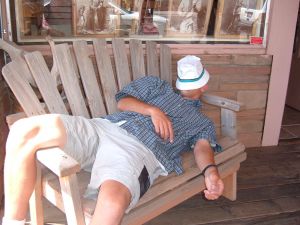
With the movies we've seen so far, it seems like everybody's first reaction is always that the movie was too predictable. "I knew the boy was going to get eaten in Jaws, I knew the girl had to die in Flying Daggers, and the love plot in Casablanca was cliche, etc." The thing is, there really wasn't anything that the directors could have done differently. If you think about it, they say that in literature, there are only seven possible plots (man v. nature, man vs. self, man v. society, etc.), so you already are very limited with what you can make a film about. So even with variations in plots, its only natural that films would develop formulas that are proven to deliver the right message to the audience, such as the Classic style utilized in Casablanca. Really, the only way to make a completely unpredictable movie, you would have to film real life, which for most people would end up looking like the shot you see below. It is a given that an intelligent viewer will be able to predict the outcome of most every movie with a little background knowledge, so instead we should focus on the excellent uses of the various film styles shown in these films.


Sunday, September 13, 2009
House of Flying Daggers of Predictability
House of Flying Daggers is an interesting movie, Chinese, yet still it was filled with many typical American Hollywood characteristics. It has the makings of a great kung-fu/martial arts movie, touching on politics and ethics, but eventually we find out that the main point is not dealing with the government but rather a love story. It's the classic Hollywood setup: two opposing sides. A member of each side runs into the other. They both at first dislike each other but they fall in love. Then of course either one or both of them has to die. A typical Romeo and Juliet scenario. Especially the end battle here:
Very preditictable in the sense that they wanted to make it very epic like when the weather randomly changes from fall-like to a heavy blanket of snow within 5 seconds. One is the jealous man who also loves the main female character and the other is her true love and both of course have to basically duke it out to prove almost which one is more worthy.
Many of the fight scenes in the movie take the 'Matrix' approach to things with the camera following the blade or arrow as it travels towards its victim in an almost slow-motion way. They probably did this to appeal more to American people and the style of fight scenes we are used to as well as to try to keep Asian interest by keeping the kung-fu style there. Personally, I think this strategy worked because I loved the fight scenes. It was the type that just made me go "OH MY GOSH!! That is so cool!". However, not everyone likes this style yet it was used in every single fight scene. They tried to Americanize the movie a little too much (with the slow motion, the predictable ending, etc) but I think it was successful in selling it to most of the American people :)
Very preditictable in the sense that they wanted to make it very epic like when the weather randomly changes from fall-like to a heavy blanket of snow within 5 seconds. One is the jealous man who also loves the main female character and the other is her true love and both of course have to basically duke it out to prove almost which one is more worthy.
Many of the fight scenes in the movie take the 'Matrix' approach to things with the camera following the blade or arrow as it travels towards its victim in an almost slow-motion way. They probably did this to appeal more to American people and the style of fight scenes we are used to as well as to try to keep Asian interest by keeping the kung-fu style there. Personally, I think this strategy worked because I loved the fight scenes. It was the type that just made me go "OH MY GOSH!! That is so cool!". However, not everyone likes this style yet it was used in every single fight scene. They tried to Americanize the movie a little too much (with the slow motion, the predictable ending, etc) but I think it was successful in selling it to most of the American people :)
Monday, September 7, 2009
Reading Response: Profit margins=pointless films
In the excerpt from the Oxford Guide called "Concepts of Culture: cultural policies and the cultural industries," Nicholas Garnham discusses the effects on mass consumerism in our profit driven capitalism on the cultural industries, which include the film industry. Previous class readings and discussions showed that the "auteur theory" is not truly applicable to films; films are not works that purely display the meaning intended by a single creator, but a product for profit created through the work of hundreds of people under the direction of the studio. Despite this handicap though, the film is still a legitimate medium that can convey important insights into human nature and social phenomenon, just like any book, painting, or other work of art.
Unfortunately, according to Garnham's essay, the studios have come to the point where they must aim at audience maximization when producing, drawing as many people to the film as possible to maximize profit before the film hits the underground market. To do this, the industry often relies on formulaic plots, such as this example from comedy website Cracked.com:
Unfortunately, according to Garnham's essay, the studios have come to the point where they must aim at audience maximization when producing, drawing as many people to the film as possible to maximize profit before the film hits the underground market. To do this, the industry often relies on formulaic plots, such as this example from comedy website Cracked.com:
Ultra-Masculine Action Star Gets Stuck With Small Child or Children

When Hollywood discovers a plot line that draws large crowds, they then produce several other releases with an identical idea because they are sure it will work. The result is a string of unoriginal movies with no intellectual value, defeating the purpose of film as an art.
The thing that Hollywood has not fully grasped, is that audiences will in fact go see a movie with a controversial, thought driven plot, as long as it still has an effective amount of special effects, action, and sex thrown in to appease the less cultured class of movie viewers. For example, the recent film, Watchmen, directed by Zach Snyder, made over $50 million profit. It not only contained a plethora of action, fighting, sex scenes, and effects, but was also driven by a highly philosophical plot, where a utilitarian genius creates world peace by nuking all the world's major cities. After much infighting and thought provoking discussion, the heroes decide that the controversial action is in fact justified, and kill the remaining dissenter to keep the peace, as seen in this clip:
This is proof that film makers can afford to take risks with their plots and still be successful economically. Once Hollywood adopts this viewpoint across the board, film will regain its place as a respectable, meaningful art form.
Wednesday, September 2, 2009
Dun...Dun... Shark Attack!
Jaws, was a great movie from many view points. Spielberg did a great job using all of the tools at his disposal to create a scary movie. Using society's fears against them is a powerful weapons as you can see from the movie. Also if you look at statistics from beach attendance the year Jaws was released, one will find that attendance was at a record low.
There are many aspects to this movie that play with the audience's senses. Spielberg leads us on to believe that every time you hear the characteristic "Dun..Dun" melody of music a shark attack is coming. Well most of the time this is true, but it creates almost a similar situation to that of Pavlov's dogs. One begins to associate a sound with a particular action or occurrence.
There are also many background issues that are highlighted in this movie, by the rule of thirds Spielberg highlights the importance of certain characters throughout the movie so the audience's eyes are guided toward the center of the screen. Also the camera zooming in and out draws significance either toward or away from the characters depending on the surroundings. This was used much in conjunction with shark attacks to put emphasis on "Jaws".
There are many aspects to this movie that play with the audience's senses. Spielberg leads us on to believe that every time you hear the characteristic "Dun..Dun" melody of music a shark attack is coming. Well most of the time this is true, but it creates almost a similar situation to that of Pavlov's dogs. One begins to associate a sound with a particular action or occurrence.
There are also many background issues that are highlighted in this movie, by the rule of thirds Spielberg highlights the importance of certain characters throughout the movie so the audience's eyes are guided toward the center of the screen. Also the camera zooming in and out draws significance either toward or away from the characters depending on the surroundings. This was used much in conjunction with shark attacks to put emphasis on "Jaws".
"Jaw(s)" Dropping Movie
The film Jaws, directed by Spielberg, is an example of how Hollywood transitioned to make action-packed and technologically advanced films. These films were able to draw back in the moviegoers that Hollywood had lost to other forms of entertainment such as the television, VCR, and HBO. Jaws was an appealing movie to audiences because of its ability to keep viewers glued to their seat in suspense of when the next shark attack would occur on Amity Island. Not only does the film incorporate new technology such as the use of a realistic shark but it also evokes intense emotions out of the viewer. In the clip shown above, the chief encounters the shark face-to-face. His silence after this encounter is effective in making the viewer share this fear and shock. After he steps back into the cabin, he says that they need a bigger boat and this is important because it is when the true power and strength of the shark become a reality for the chief.
Friday, August 28, 2009
Subscribe to:
Posts (Atom)